


Proxies are designed to mask your IP address, making your online activities more private and secure. Today, proxies are becoming increasingly popular with various types available. Datacenter proxies are still one of the most common for many users. Naturally, they have both positive and negative aspects. Understanding both sides will help you assess whether it is right for your needs. What is a datacenter proxy? What are its pros and cons? And what are they most commonly used for? Keep reading to find out.
What Are Datacenter Proxies?
As the name suggests, datacenter proxies use IP addresses provided by data centers. Like other types of proxies, it acts as an intermediary server between your device and the internet. When you use a datacenter proxy to access the internet, websites see the data center’s IP address, not your real IP address. The process works as follows:
- You use a datacenter proxy to access a website.
- Your request is first sent to the proxy server.
- The server forwards your request to the target website using its own datacenter IP address. What the target website sees is the proxy’s IP, not yours.
- The website processes the request and sends the response back to the proxy server.
- The proxy server forwards the response to your device.
By routing your traffic through an intermediary server, datacenter proxies hide your real IP address while delivering fast connection speeds and efficiently handling a large number of requests. In the next section, we will explore their key advantages in more detail.
Key Benefits of Using Datacenter Proxies
Datacenter proxies are among the most preferred types of proxies chosen by both individuals and businesses. Their speed, affordability, and scalability make them a practical choice for a wide range of online tasks. Here are four undeniable benefits.
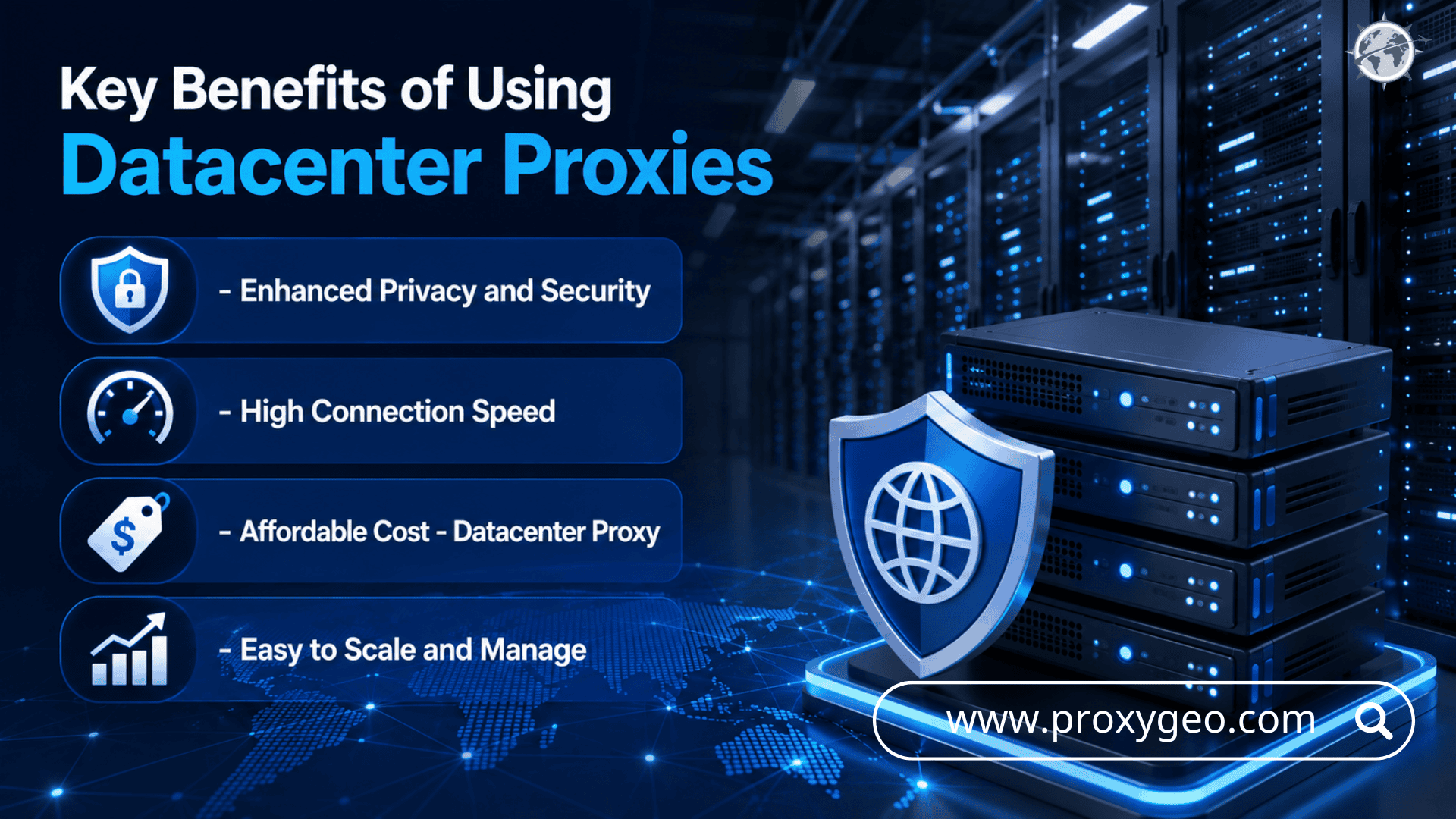
1. Enhanced Privacy and Security
Proxies are designed to improve privacy when accessing the internet. Datacenter proxies are no exception. When you connect through a datacenter proxy, your real IP address remains hidden. Websites and online platforms only see the proxy’s IP address rather than yours, making it much more difficult to identify your actual device or location. Furthermore, masking your real IP address with a datacenter proxy reduces the risk of being tracked or having data collected directly from your connection. As a result, you can rest assured that your online activities become much more private and secure.
2. High Connection Speed
Privacy is only one of the reasons why datacenter proxies are so popular. Their superior speed and performance make them even more attractive to users. So how are they superior? Datacenter proxies operate on dedicated servers with robust network infrastructure, ensuring fast response times with minimal latency. Unlike some other proxy types that rely on consumer internet connections, they operate entirely within professional data centers. This makes them an excellent choice for tasks that require sending a large number of requests in a short period, such as web scraping, website testing, and other high-performance online activities.
3. Affordable Cost – Datacenter Proxy
Compared to other types of proxies, such as residential proxies, datacenter proxies are significantly more affordable. Because they are located in data centers, providers can deploy and manage thousands of IPs on the same server infrastructure, significantly reducing operating and maintenance costs. Additionally, datacenter proxy providers often offer flexible packages based on bandwidth usage or the number of concurrent connections required. Therefore, it is easy to choose a package that best fits your workload and budget. Overall, if your budget is tight, this is definitely a significant advantage worth mentioning.
4. Easy to Scale and Manage
If you are not technically savvy, the scalability and ease of management of a datacenter proxy will certainly please you. If you need to scale up, you add more servers or increase bandwidth without worrying about geographic limitations. This makes it easy to expand your proxy infrastructure whenever your workload increases. Furthermore, most proxy sellers also often deliver user-friendly control panels or APIs, making it simple to manage IP addresses, monitor usage, and configure your proxy settings. Even users with limited technical experience can easily deploy and manage datacenter proxies.
Drawbacks of Using Datacenter Proxies
While datacenter proxies bring valuable benefits, they also come with a few limitations. Understanding both their strengths and weaknesses will help you determine whether they are the right choice for your specific needs.
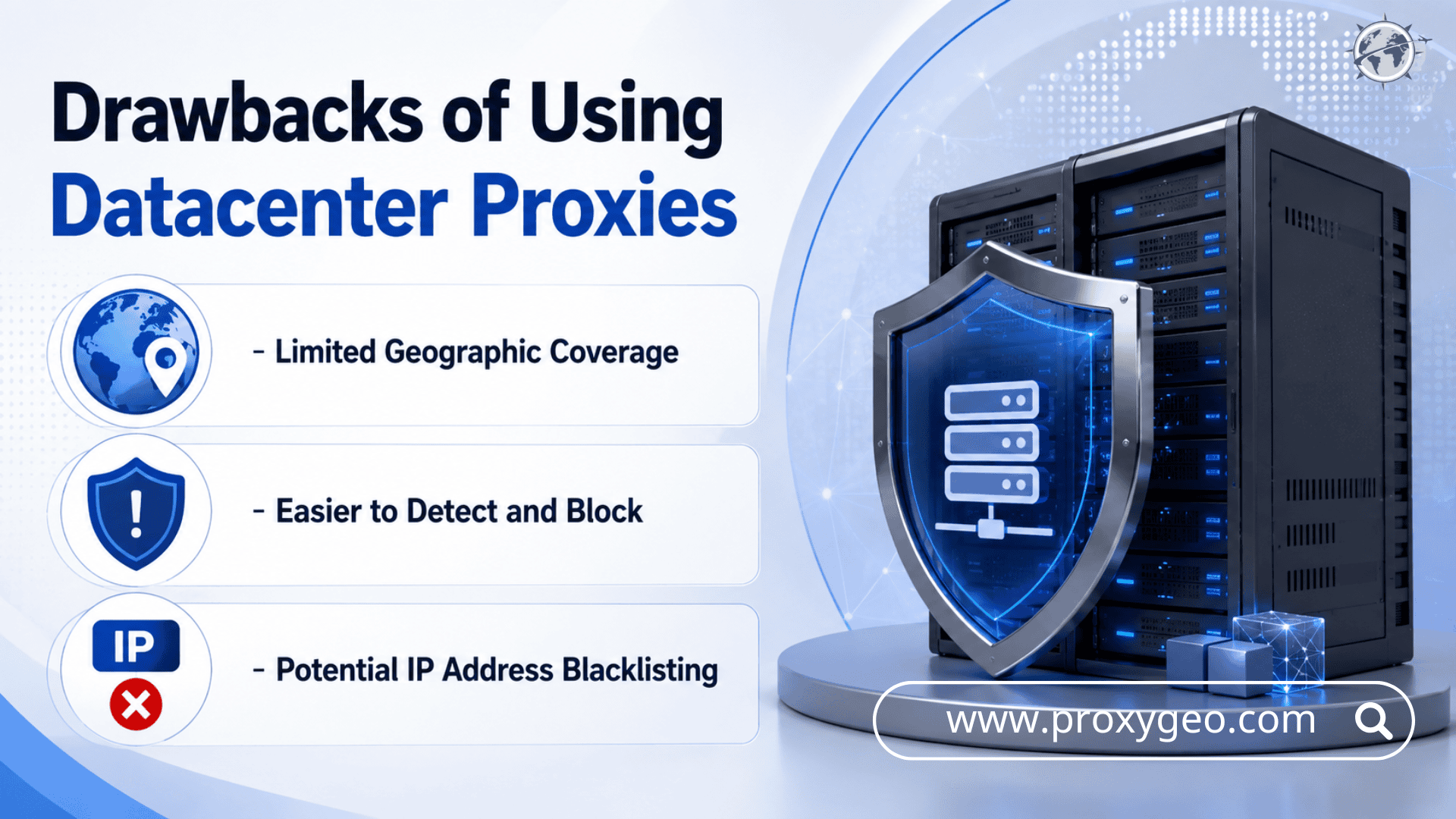
1. Limited Geographic Coverage
Datacenter proxy geographic coverage is generally less diverse than that of residential proxies, which rely on IP addresses from real users in different countries, cities, and regions. As a result, datacenter proxies may not always be the best choice if you need IP addresses from less common locations or want to target highly specific geographic markets.
2. Easier to Detect and Block
Unlike residential IP addresses, datacenter IPs are not assigned by Internet Service Providers (ISPs). Instead, they originate from data centers, making them easier for websites and online platforms to identify. So, they are more likely to be blocked or flagged as suspicious activity.
3. Potential IP Address Blacklisting
Many users may use the same IP address range provided by a proxy service for different purposes. If just one user engages in malicious activities such as spamming or violating website policies, the entire IP address range can be blacklisted. In this case, even if you follow all the rules, you might still experience blocked access, repeated verification requests, or reduced success rates for automated tasks.
Datacenter Proxy: Common Use Cases
Each type of proxy has its own advantages and disadvantages. Besides choosing the right proxy, using it for the right purpose is equally important. Below are some of the most common and effective use cases for datacenter proxies.
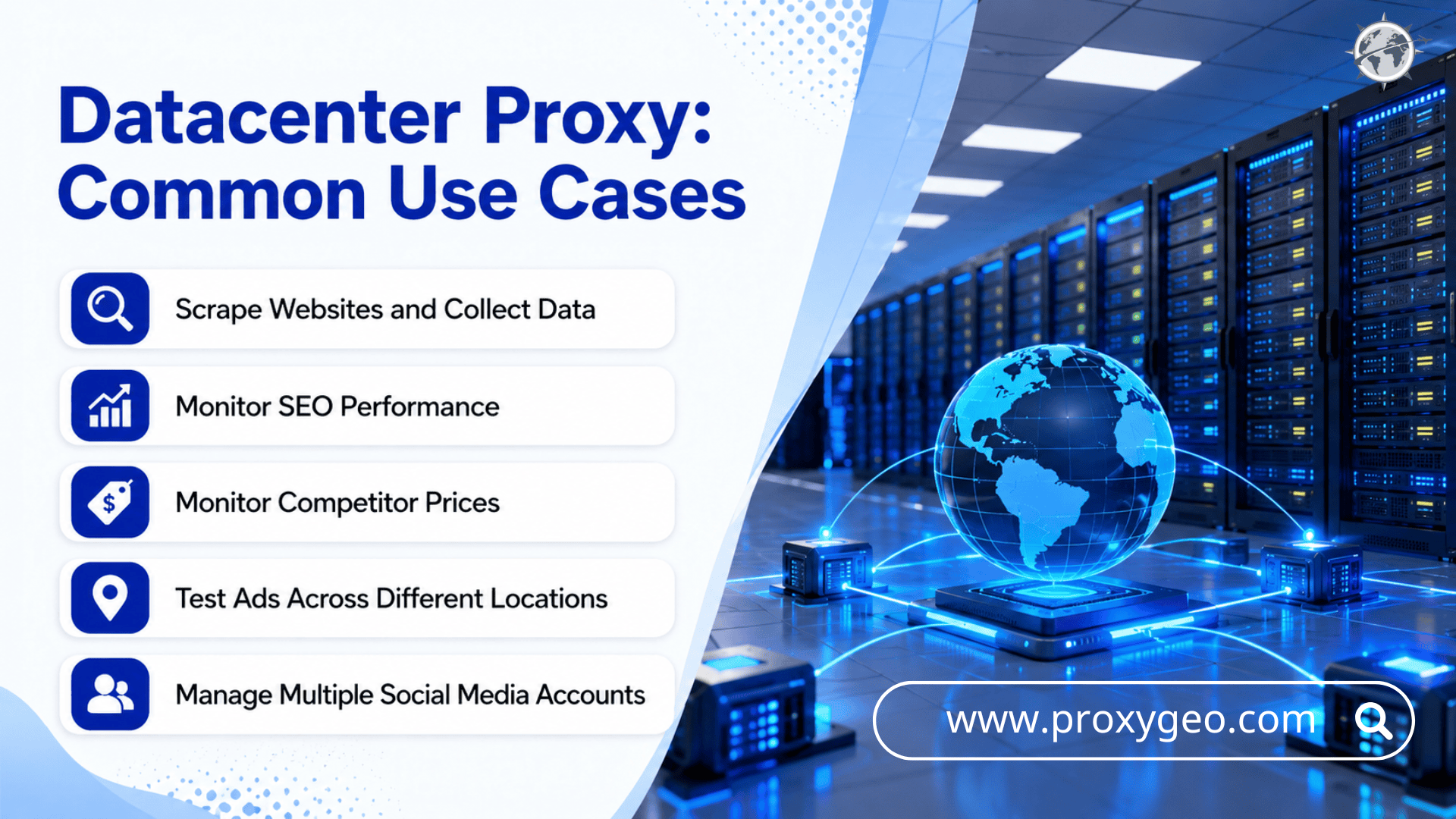
1. Scrape Websites and Collect Data
Datacenter proxies are widely used for web browsing and large-scale data scraping. With the right configuration, they can handle thousands of simultaneous requests without overwhelming the server. People often use a large number of variable IP addresses to distribute traffic, reducing the risk of being restricted or blocked from accessing the network.
2. Monitor SEO Performance
SEO professionals typically use this type of proxy to monitor search engine rankings from different locations. Data center IPs facilitate checking search results without incurring high costs. It also minimizes the influence of personalized search history and user-specific ranking factors. For best results, a rotating proxy should be used so that each query appears to come from a different user.
3. Monitor Competitor Prices
If you sell products or services online, monitoring your competitors’ product prices is essential to understanding the market and adjusting your business strategy. Datacenter proxies enable you to hide your IP address and monitor pricing from different locations. You can configure scraping tools to collect pricing data from dozens of competitor websites at regular intervals without being blocked. However, it is crucial to diversify your proxy endpoints to show as many independent users as possible.
4. Test Ads Across Different Locations
Ad content often displays differently depending on the user’s country or region. By using datacenter proxies with IP addresses from different locations, you can verify how your ads are displayed across various markets. This makes it easier to identify display issues, confirm geo-targeting accuracy, and make timely adjustments to your advertising campaigns.
5. Manage Multiple Social Media Accounts
If your job requires managing multiple social media accounts simultaneously, consider using a datacenter proxy. Assigning a different IP address to each account helps separate login activity and reduces the risk of IP-based restrictions. It is best to use different IP addresses for different accounts and keep them consistent to ensure better reliability.
A datacenter proxy is an excellent choice for users who prioritize speed, affordability, and scalability. It is ideal for tasks such as web scraping, SEO monitoring, competitor price tracking, and geo-targeted ad verification. However, due to geographical limitations, it is easier for websites to detect and block this type of proxy. If your projects require a higher level of anonymity or better success rates on sensitive websites, residential proxies from ProxyGeo may be a more suitable alternative.

Thank you for taking the time to read this article.
For more information, feel free to contact us at PROXYGEO.
